
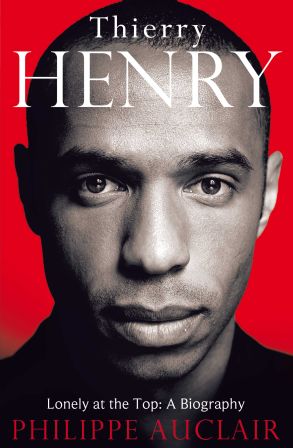
“All I know most surely about morality and obligation I owe to football”,
Thierry Henry, Lonely at the top
Return to the book list for this category.
Philippe Auclair, London, Macmillan, 2012 ISBN 978-0-230-74839-2
Philippe Auclair’s excellent book is in his own words “a biographical essay rather than a biography”. He elaborates that as in the modern world all Henry’s career highlights are available at the click of a mouse. Moreover such an approach is not only unnecessary but "instead of providing the necessary devil, would more often than not obscure its purpose”.
The purpose for Auclair “is to try to understand how and why such a magnificent footballer, whose achievements should be beyond criticism has inspired such extremes of feeling… mistrust, detestation as well as unconditional love”. The author’s own position is “an admiring ambivalence”.
The book is so well written. As a Frenchman, Auclair understands Henry’s cultural background. Yet he is sufficiently immersed in British culture to compare an aspect of Henry’s play to a Shane Warne leg break and to refer to twin strikers by analogy to Laker and Lock.
He is clearly a fan of Thierry Henry and someone who has followed Henry’s career very closely yet this does not stop him from making critical judgements when he feels they are justified.
The reader is given helpful insights Henry’s childhood – growing up in a rough area of Paris with a father who is portrayed as controlling and hyper-critical. Years later Henry is quoted: “And when you’re fourteen, its difficult to understand that your dad is doing you harm.” There is another incident when the 10 year Henry has scored 6 goals in a game and all his father wants to talk about is the chances he missed and the times he failed to control the ball. The paragraph ends with TH quoted as “Every game was like that.”
The author rightly places Thierry Henry at the pinnacle of football commenting on his ability: “to make the exceptional look ordinary”. He also suggests that Henry “could be counted among those exceedingly rare players who come to embody an era of English football as a whole, as George Best or Eric Cantona had done before him”.
At the same time he writes: “Thierry was not an easy footballer to feel genuine affection for, regardless of how much you admired, even revered him”. He is a portrayed as a man with very few real friends. Part of this is attributed to Henry’s difficulty in trusting anyone.
On the negative side, there is the argument that Henry never turned up for the really big games. He didn’t score in any of the nine major senior finals he played in – with the exception of the 2003 Confederations Cup trophy, arguably the least important.
The book devotes a chapter to the infamous ‘Hand of Gaul’ incident, which, the author suggests may “define him … far more than the titles and honours” he’s accumulated. The author is also critical of Henry’s lack of standing up and being counted as the French team imploded in the 2010 World Cup.
There is also a fascinating analysis of why Zidane and Henry never seemed to play well together.
The book is a cut above the average football biography. Well written, with many provocative insights, the author paints a balanced picture of Henry. I would be amazed if this book is not in the running for sports book of the year.