
"It matters a great deal who is going to win, but not at all who won"
The second half
Return to the book list for this category.
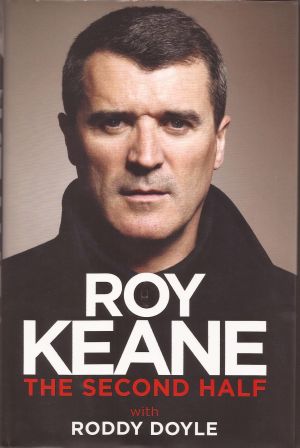
Roy Keane, London, Weidenfeld and Nicolson, 2014. ISBN 978 0 297 60888 2
Roy Keane is an engaging character and his book does not disappoint.
He is brutally honest about the challenge of realizing that your career as a footballer is over: “You lose your identity. You lose what you stand for. For years you strive to be a footballer. Then you have it. You’re like an actor, every Saturday. Then it’s gone”. He adds: “But I also knew that whatever I did it would never be as good as playing football”.
The poignant moment of leaving Manchester United is well described. He also acknowledges the effect on friends and family some of whom had been coming over from Ireland to see me and to get a game in, who would certainly miss “the buzz that football and my career had brought them”.
The transition to management is another excellent section, how well prepared he was as a Premier League captain with his coaching badges yet how ill-prepared to deal with players with marital or gambling problems, family tragedies or the police coming to arrest a player. As he puts it “they didn’t teach me this [in the UEFA A course]”.
The challenge of becoming a manager at a club with lower expectations is summed up as “the hard part about going to Liverpool or Manchester United when you’re a manager is almost having to accept that you’re going to lose 1-0 or 2-0, and go, ‘That’s not bad.’” He also comments on the difficulty of seeing players’ euphoria in gaining promotion to the Premier League and fulfilling their dreams whole knowing that many of those players will have to be replaced if the club is to survive at the higher level.
And on management, I leave you with a one-liner on the two great managers he played under: “I think Brian Clough’s warmth was genuine. I think with Alex Ferguson it was pure business”. You will have to buy the book to read his evidence to support this!
The book involves more self-analysis than I would have expected such as:
A reflection on anger: “Anger has always been part of my personality. I don’t see it as a bad thing or a bad word…I’ve looked at my anger for what it is. It’s just anger; I won’t beat myself up about it”.
On management: “I don’t think I’m a bad manager, but at Ipswich I managed badly.
And on life: “I just wish I was a bit more relaxed, although I still think I have to be on my guard. In the past, when I have relaxed and let people into my space, they let me down - I’ve had that experience. So I think I have to keep that guard up, a little bit. But not to the extent that I have in the past”.
While not giving anything away about his personal faith, he twice refers to the importance of his children going to a Catholic school.
Overall an excellent book, well above the average football autobiography. Great insights into the world of football.