
"Lord, I don't ask that I should win, but please, please don't let me finish behind Akabusi."
The Keeper
Return to the book list for this category.
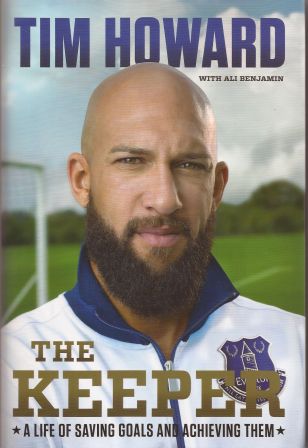
Tim Howard, Harper, 2014. ISBN: 978-0-06-238739.4
Tim Howard has for years been one of the best goalkeepers in the Premier League. His display for USA against Belgium in the 2014 World Cup arguably moved his status even higher.
At an early age he was diagnosed with obsessive-compulsive disorder, or OCD, and TS (Tourette Syndrome). He writes honestly about the challenges that the condition brought and his work to help others deal with it. I once did a one to one interview with Tim and asked him about suffering with Tourette and he immediately told me he did not accept the word “suffer”. He makes the same point in the book: “I have Tourette Syndrome. I live with TS. I try to excel with TS. What I don’t do is suffer from TS. And you don’t have to, either.”
The contrast between playing for Manchester United and for USA is well expressed. In Manchester he could not go out without being mobbed or abused. In the USA he might be the starting goalkeeper in the national team but no one knew who he was. He addresses the mistake he made which led to Manchester United’s exit from, the Champions League to Porto with guts and honesty. He gives real insight into the pressure of his profession.
The story of his marriage and his decision to end the marriage is told: “Relentless striving comes with a price. For me, the price was my marriage…I knew I didn’t want to be married to Laura any more. I was addicted to my job”. When his wife Laura suggested talking about the issues to her or a friend, he was unwilling; mind made up.
Faith is raised at several places in the book but it is hard to summarize quite what his faith is. He pretty much admits that saying: “I remain a religious man to this day. But over time, my faith would change and mature. It would become more complex, more private, much harder to define”.
His mother was Catholic but he was more influenced by his grandmother and “the inner peace she’d always projected”. At his MLS team the Metrostars, he started a players’ Bible Study and found a team chaplain. Laura’s mother was “a devout Baptist” and Laura is quoted as suggesting they speak to “our pastor” about the marriage issues. However Tim makes no reference to church going or any involvement with a Christian fellowship beyond the Metrostars. He refers to religious rituals - making the sign of the cross and saying the same prayer for his children before every game and having Christian tattoos.
Twice he quotes what Laura’s mom said to him just after the wedding: “You two will always be married, because you have God in your marriage.” But he was unable to live up to it.
The book is annoyingly American; his co-author is described as living in rural Massachusetts with her husband and two children, “all ardent soccer fans”. I found myself irritated to be told that the city of Liverpool has two Premier League clubs and that when they meet it is a “derby pronounced ‘darby’” and that the Charity Shield [which has been contested since 1908] is a kind of Super Cup. Incidentally, you might like to make a note that every game in the Premier League is important as, the book tells us, there are no play-offs to decide the championship! When the co-author writes of Sir Alex Ferguson: “You’ll never win with kids, he’d been warned by pundits”, she seems unaware of what any UK football fan would know instantly that it was not unnamed pundits but Alan Hansen who made the remark.
For me a good book is somewhat spoiled by being so slanted to an audience in America, where by Howard’s admission he is unknown rather than an audience in the UK where he finds it impossible to go out for a quiet meal without constant interruptions.