
"there has only ever been one perfect man, the Lord Jesus, and we killed him. I only missed a putt."
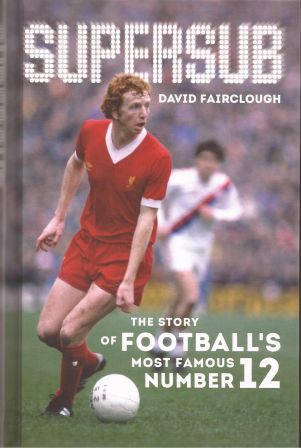
Supersub
Return to the book list for this category.
David Fairclough, Liverpool, de Coubertin Books, 2015. ISBN: 978-1-909245-28-0
This is a well above average footballer autobiography. It tells the story of a Liverpool legend but at the same time makes a real contribution to the social history of English professional football.
How life has changed over the 35 years since Fairclough was at his prime as a Liverpool player! As a Liverpool first-team player he was living with his parents in their council house and at times taking the bus to training. He went on holiday to Butlins and met an England international there! Today’s Liverpool prayer would drive his Bentley from his mansion on the Wirral in order to catch his flight to his break in the Caribbean.
For the top clubs today the Premier League and Champions League are the real targets. On the other hand Fairclough states: “Kids of my generation didn’t dream about winning the league – they dreamed about playing at Wembley in the FA Cup final”. Winning the UEFA Cup was also considered very important for Liverpool in his day; nowadays managers rarely pick their strongest team for the UEFA Cup/Europa League.
The title – for those too young to remember Fairclough – refers to the fact that of his 154 competitive appearances for Liverpool 62 saw him come on as substitute, not to mention 76 games as unused substitute. “Substitute” is singular as in those days only one sub was allowed in domestic football. Fairclough also developed a reputation for scoring vital goals off the bench. Not that he was at all comfortable with this role, saying “With the exception of my first few months as a first-team member I honestly hated being substitute. Worse than that was being an unused substitute”.
He is very honest about his feelings as he sat on the bench and a team mate went down injured: “I once coined a phrase that used to have my mates roaring with laughter. When someone went down injured I’d say, ‘I hope it’s nothing trivial.’ It was a tongue-in-cheek comment but one barbed with a semi-serious undertone”.
He scored the only goal of a Liverpool Everton derby. Late in the game, the reds got a penalty. Fairclough openly admits to hoping that Phil Neal would miss – and he did – so that his goal would be the winning goal. Again he acknowledged that watching the team from the bench was not easy. His desire for his team to win was always tempered with the thought that a comfortable victory not only meant that he was unlikely to be needed in the game but also that his chances of getting into the team for the next game diminished.
Bob Paisley is a Liverpool legend but Fairclough is very critical of him, seeing him as weak and lacking integrity. On one occasion Paisley told the players the he had not decided on the team and would wait to check the weather and the pitch in the morning. Fairclough then bought an evening paper, where he read the starting 11 and that he was on the bench - in an article by a journalist known to be Paisley’s mouthpiece. Then there was the time Paisley left him out of the FA Cup Final team assuring him that he would be involved in the European Cup Final 4 days later – only to leave him on the bench throughout. Fairclough described it as “Paisley used the carrot of playing in Rome to try and soften the blow of being left out at Wembley… I felt it was a cowardly way of letting me down”. When Fairclough did play in a Wembley final, Paisley made him sweat until almost an hour before kick-off, before telling him. He adds that when he played for lesser clubs – Beveren and Lucerne – that the treatment of players was much better than at Liverpool.
There is a motiv of disappointment and underachievement running through the book which these three quotations illustrate: “I do harbour a sense of resentment at how my career panned out…there’s absolutely no doubt in my mind that I could have made a bigger impact at Liverpool”, “In my opinion Bob Paisley didn’t fully utilise my potential. He failed to use me in the best possible way. And it’s something that still haunts me to this day” and “As I walked towards the door he [Bryan Hamilton] said one last thing, and it’s a sentence that has lived with me ever since. It was that I never fulfilled my potential. And it’s true. Part of me still feels I didn’t achieve as much as I should or could have…that is why I’ll forever have some regrets about my football career”.
An excellent book with honest analysis of his 16 year career in professional football – eight at Liverpool and eight after Liverpool – as well as fascinating insights into the life of a professional footballer in the 1980s.