
"It matters a great deal who is going to win, but not at all who won"
Commitment
Return to the book list for this category.
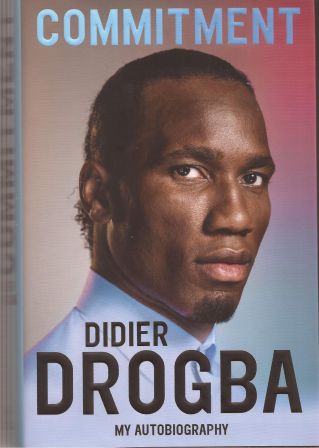
Didier Drogba, London, Hodder, 2015. ISBN 978 1 473 62070 4
Didier Drogba is without question one of the best overseas players ever to play in the Premier League. His 104 League goals in 254 appearances only tell part of the story. His late equaliser and winning penalty took Chelsea to their first even Champions League win. He has also scored a remarkable eight cup final goals at Wembley. On top of that he helped take Ivory Coast to the World Cup finals for the first ever time in 2006 and again in 2010 and 2014.
He comes across as very modest, saying several times that he is not the most talented player and that his success is down to hard work.
His assessment of the managers he has played under is one of the most interesting parts of the book.
Jose Mourinho, for example, “brings a winning mentality to all the teams he manages…[and] one of the manager’s many qualities is his ability to listen”.
Luiz Felipe Scolari The problem, as I saw it, was that Scolari had no previous experience of Premier League football and of the enormous physical demands it makes on players.
Carlo Ancelotti telephoned Drogba when he was appointed manager of Chelsea to say that he was looking forward to working with him and when he left he made sure he said goodbye on good terms. “In both instances, he didn’t need to do that. But then, as I’ve already said, he’s a class act”.
Drogba’s contributions away from football have been impressive. He set up his own foundation to help health and education in his home country. Since 2007, he has donated all his commercial earnings to the foundation. There is a chapter on the foundation in the book. He was responsible for taking an international game to the North of Ivory Coast, which had previously been in rebel hands, as a gesture of peace and unity.
There are at least 15 references to faith in the book. He writes: “I spend my time praying during games, asking God to help me, asking him to show me. People might be surprised at how often this happens, but my faith drives everything I do, both on and off the pitch. I really truly believe there is something, someone, helping me to be, not just a better player, but a better person. That is more important than anything to me, especially now that I am coming to the end of my football career. I was brought up in the Catholic faith, we all went to church, and God has always been in my life and that of my family”.
At the same time there are a number of odd and inconsistent faith references in the book, for example his strong belief in destiny and that certain things were not meant to be. He gives examples of praying that he would score and attributing the goal to God. He refers to a visit to the Catholic basilica of Marseille which “would maybe give us a bit of divine good fortune” and “Maybe the gods were looking down on us that evening”. He describes the moment when Cameroon had a penalty which would take them into the 2006 World Cup finals at the expense of Ivory Coast when the team were all praying that Cameroon would miss the penalty and the same situation in the 2014 World Cup when his prayers for a Greek player to miss a penalty were not answered.
Didier Drogba was an outstanding football. He is a fine human being and the book is compelling reading.