
"I love the sense of satisfaction that I get when I’ve done a swimming workout or race, and know that I gave my whole being and heart to God in every moment of the swim. It’s the best worship I can offer him."
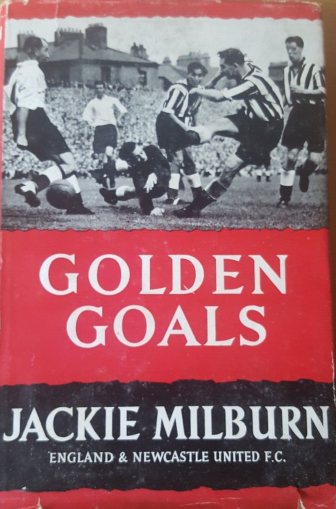
Golden Goals
Return to the book list for this category.
Jackie Milburn, Stanley Paul, 1958
There are so many contrasts between Milburn’s life in the 1950s and the present day. Milburn is playing for Newcastle United but working in the colliery at the same time. Similarly it seems bizarre to us that he should learn of his selection for England by reading about it in a newspaper.
The book tells us that he was earning £15 per week plus £3 for a win but less in the close- season. And he states that he was satisfied with what he earned. He argued strongly that football is a team game and that all players need to be paid the same amount. He lived in a normal house, initially renting from Newcastle United. Preparation for games was different too with Milburn routinely going to the cinema on Friday night.
He was struck in Rio that Copacabana was a millionaire’s paradise – the modern player would be one of the millionaires.
He was ahead of his time writing a column as a player and actively writing it and delivering it the newspaper office.
He writes of real excitement about the 1950 World Cup, England entering for the first time. He expresses similar excitement about flying to Brazil – amazingly from our perspective, via Paris and Dakar. He was injured and missed the 1-0 infamous defeat to USA. His reaction to the World Cup experience is interesting: that the England players were struck by how much more professional the teams they played against in 1950 and with the amount of thought and preparation that went into their play in contrast to England.
Examples of how football has changed include his comment that every professional footballer nurses the ambition to play for his country and win an FA Cup medal – how the FA Cup has diminished in value. When Newcastle won the 1951 FA Cup semifinal, it was immediately announced that the same 11 player would play in the final, as they had earned the right to do so. And when the manager chose the team for the 1955 Cup final, the directors overruled him and made a change. Both are utterly unthinkable in the modern era.
Despite both the 1952 and 1955 Cup finals seeing a serious injury that resulted in a team playing with ten men for most of the game, Milburn is uncertain about whether subs would be a good thing.
A fascinating perspective of football in the 1950s.