
"Football is not a matter of life and death, it is more important than that."
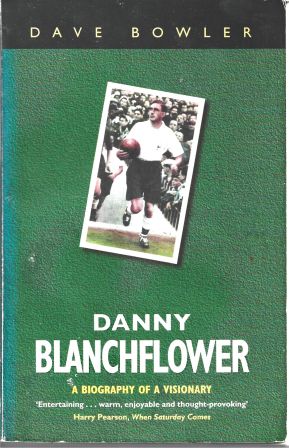
Danny Blanchflower: A biography of a visionary
Return to the book list for this category.
Dave Bowler, Vista, 1997 ISBN0575602384
Danny Blanchflower is remembered mainly as the captain of the Tottenham team which did the (league and cup) double for the first time in modern history in 1961 and as the captain of the Northern Ireland team which reached the quarter finals of the World Cup in 1958.
The book presents Blanchflower in many ways as a visionary, a person ahead of his time. When he started his career in the late 1940s and early 1950s, professional football clubs were run by a board of directors who picked the team - not the manager. Training was almost exclusively fitness, running - without a ball. Football teams played in a rigid 2-3-5 formation.
Blanchflower is credited with changing much of the culture - as team captain he would give the team talk, make tactical changes during the game, play 4-2-4, encourage defenders to attack at corners etc - all these things seem perfectly normal but were unheard of in the 1950s. The book describes him as naturally inquisitive, giving an example of playing in an international against Switzerland who lined up 3-3-4. Blanchflower’s reaction was to get his club to play in that formation in a practice match.
The book describes (133-4) how the IFA’s rules which banned Sunday football, almost stopped Northern Ireland going to the World Cup and quotes Blanchflower’s famous maxim that the Northern Ireland tactics were to equalise before the other team scored.
The book gives an interesting insight into the success of Northern Ireland and the failure of England at the 1958 World Cup, suggesting that Northern Ireland with a small squad had a very settled team and credits Blanchflower with the ability to change the formation as the game developed. In contrast the England manager, Walter Winterbottom, is quoted expressing his frustration that playing for England had become a reward for doing well at club level. Rather than building a team to win matches there was a tendency a to chop and change to give everyone in the squad a chance to play.
An interesting book on a thinking footballer who was way ahead of his time.