
"I love the sense of satisfaction that I get when I’ve done a swimming workout or race, and know that I gave my whole being and heart to God in every moment of the swim. It’s the best worship I can offer him."
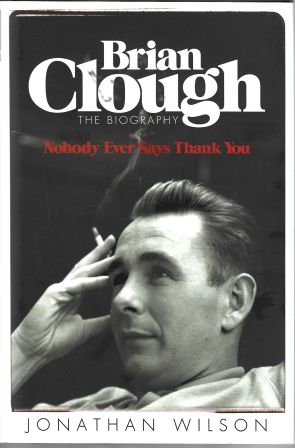
Brian Clough: Nobody ever says thank you
Return to the book list for this category.
Jonathan Wilson, London Orion Books, 2011 ISBN: 978140912317 0
There have been several books by and about Brian Clough but none as comprehensive as this one. The book runs to 565 pages in five chapters with a simple chapter title of the years covered, for example 1935-62. This is a brilliant book but my one criticism is that it is too long - partly because of the comprehensive game by game account of every season - which I felt we could have done without. The title of this book comes from Harry Storer, a football manager, to whom is attributed the quote” football is a world in which nobody ever says thank you”.
I am old enough to have seen Clough play but for younger readers the first chapter is a helpful confirmation of what a good player he was. He is described as “the best centre forward in the northeast until Alan Shearer”. He scored 43 goals in 1958-9 season. He was first and foremost a goal scorer who worked hard at his trade “practising for up to an hour every day after training shooting first time” - shooting first time meant that a defender had no time to make a tackle.
There are reminders of how different the game was in those days with a reference to a particular player having a car - which was very unusual in the early 1960s. Despite playing only in the second division he was capped for England and was close to selection for the 1958 World Cup. The book states that the England manager, Walter Winterbottom, did not like him “thinking Clough was more trouble than he was worth”. Winterbottom was apparently not the only one not to like him; when Clough was made club captain there was a petition from the players for him not to be captain!
His playing days came to an end with a career ending injury. “There in that moment, his life changed; he became a different person, one who could no longer play football at the highest level”. It is difficult to imagine what a devastating blow this was, so early in his career.
When he was a player at Middlesbrough he got to know the team’s goalkeeper, Peter Taylor. The relationship between Clough and Taylor runs through the book - how together they had great success as a management team, yet it seemed always a fragile relationship resulting in splits. Another running theme is how Taylor felt that he was never given credit for his contribution and certainly did not get his share of the financial rewards that came Clough’s way. They did not have a relationship beyond football and rarely socialised together. Taylor had a great gift for spotting potential in a player, for example, watching John McGovern aged 16 in an amateur game seeing something in him which would lead to him captaining the European Cup winning team 15 years later.
Early in the book there is a reference to “Clough’s belief in the traditions of the church” - intriguing but sadly not unpacked and not mentioned again.
A point that emerges time and again is that stories about Clough are often invented or embellished. For example Clough’s account of signing Dave Mackay for Derby County is quite at odds with Mackay’s version or Clough telling a story about being affected his mother’s death but getting the year wrong.
Clough’s achievements as a manager are remarkable: Clough had done at Derby what Shankly had done at Liverpool and Revie had done at Leeds in taking a provincial club from the second division to the First Division title and then he repeated it at Forest adding two European Cups.
How does one sum up Brian Clough? He is an enigma, a man of contradictions. Rather than trying to synthesize, I will quote some of Wilson’s descriptions:
• out of control, a wilfully controversial figure who attacked anyone and everybody
• Clough had become a monster, impossibly egotistical, falling out with all those around him even the man who
had been his closest friend, Peter Taylor
• There was an ugly, bullying edge to him at times, at tendency to strike out indiscriminately at all; this is part of his self-assertion. Alongside that there was a great spirit of generosity. He would pay for children he saw queuing up to buy tickets adding a few pounds extra.
• he punched a number of players or might kiss them.
• he had always loved the confrontation, perhaps it was even his way of dealing with pressure.
• his process of psychologically testing players of breaking them to his will.
• he seemed to delight in being awkward for the sake of being awkward.
• Not allowing injured players to be treated on the pitch.
• His relationship with the right and wrong, particularly where money was concerned, was complex and he
certainly would have had no qualms about taking what he believed was his right even if it wasn't strictly legal.
The book discusses his disastrous 42 days at Leeds United. Why did it all go wrong? Was he trying to take revenge on Revie? Why did he make no effort to develop a relationship with the Leeds United players? Why did he refuse to interrupt his holiday to take pre-season training? In his own autobiography, Clough referred: “trying to do in minutes what should have taken months even years… the biggest mistake of all was my eagerness to accept the job in the first place Leeds was not for me and I was not for them”. Wilson comments: “The experience at Leeds had chastened Clough. He had achieved so much but through his own recklessness had thrown it away, for the first time since his 11 plus he had failed”. The reference to the 11 plus is interesting as Clough seemed to have carried that failure with him into adulthood.
His behaviour at times was erratic to the point of eccentricity. The book refers to him taking
Players on a matchday for a walk from the hotel onto the motorway sitting them in the central reservation and giving a team talk. On another occasion he stopped the bus a mile from the ground and made the players walk.
He was clearly a great motivator of players. There is a story about Larry Lloyd strongly disliking Clough but admitting that Clough made him play better. One of his players said he was concerned the way they were exposed at corners with but Clough told the players that they were professional players and should be able to sort it out for themselves. Compare that to today’s free-kick and corner specialist coaches.
Let us give the last word to the man himself: “Rome wasn't built in the day but I wasn't on that particular job”