
"Football is not a matter of life and death, it is more important than that."
Jack Hobbs
Return to the book list for this category.
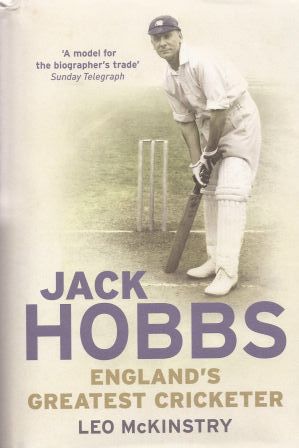
Jack Hobbs, England’s finest cricketer, Leo McKinstry, London, Yellow Jersey, 2010
ISBN 9780224083294
Jack Hobbs has a significant claim to be England’s finest ever cricketer and the book makes the case well, arguing in one section concerning the ways in which he was superior to Don Bradman. His test career stretched over 28 years and he played his last test at the age of 48. He scored 5410 runs in 61 tests and a career total of 61,760 runs including 197 centuries. Interestingly, he earned more than contemporary professional footballers.
He was a fine human being, always very popular amongst team mates. The book also records an extraordinary incident when at Australian crowd sang “for he’s jolly good fellow” as he walked off.
Hobbs’ Christian faith comes out strongly in the book. That church going was part of his life comes out naturally being mentioned several times. In his early life, for example, “He was a member of the St Matthew’s church choir, attending services and practice at least four times a week, while he also went to Sunday school and Bible class”.
His faith affected his behaviour but “his deep religious beliefs never made him a puritan or a prig”. The book refers to his generosity to charitable causes and his moral behaviour – in contrast to some of team mates his on tour. John Arlott said that Hobbs was “the best man I ever knew in my life. 1 would say this even if he had never made a run. There was something almost Christ-like about him, there really was”.
It was a largely private faith. He refused to read the lesson at a sportsmen’s church service in 1925, saying “I would rather face the Australian bowling for three weeks than read a lesson in church”. The author comments, “Mostly his faith was unobtrusive, a facet of his private sphere”.
On a tour of India, a number of games were scheduled to include Sunday play. Hobbs said simply: “I have never played Sunday cricket and never shall. My early religious atmosphere brought me up respect Sunday, to remember the Sabbath day and keep it holy, to make it a day of rest for mind, body and spirit.” The author remarked that the Sunday cricket issue was the only time Hobbs’s Christianity caused any conflict with his profession.
Despite his Christian faith he was surprisingly superstitious, observing a range of rituals that he observed in both the dressing room and the middle to bring him luck. “I ground my bat within the crease at the end of every over; and I use one corner of the players’ dressing room at the Oval for dressing – and I am always careful to put the right pad and the right boot on first.” In preparation for an important innings, he had brought a lucky four-leaf clover and was dismayed to be given room 39 (3 times 13) in an hotel.
The book refers to several incidents in his career where he was accused of unsporting behaviour: There was an incident when he edged the ball to the wicketkeeper, did not walk and was given not out. When challenged by the bowler he denied that he had hit it. Later in the pavilion he admitted to the bowler that he had been out but added I had to deny it out in the middle or I would have shown the umpire up. Other incidents referred to involved:
(i) Standing his ground when short leg claimed a clean catch;
(ii) Badgering the square leg umpire into giving a batsman out when the stumps umpire had given him not out.
(iii) Kicking the ball when he was out of his ground and in danger of being run out.
The author comments, “Such rows do not mean that Hobbs’s renowned attachment to fair play was a myth, only that, through the sepia lens of nostalgia, the extent of his chivalry has often been exaggerated. Hobbs was, after all, a competitive professional.”
To the modern reader the distinction between amateur and professional hardly seems believable – separate dressing rooms, separate gates on to the field, different meals. When the Surrey captain, Percy Fender, abolished separate lunches and teas at the Oval, and also led his team onto the field through one gate, the move prompted the outrage of some traditionalist diehards. One Surrey member said, “We felt that Bolshevism had invaded our sanctuary”.
Despite his status in the game, Hobbs never felt at home at Lords. To him, “its very structure and facilities reeked of exclusivity with the paid players treated almost as if they were trespassers in a gentlemen’s private club.“
Hobbs occasionally captained Surrey and was the first professional to captain England, something at which he felt “a profound sense of pride”. Plum Warner, however, spoke for many in arguing that the responsibility of leadership, was “better shouldered by an amateur than a professional”, not least because the amateurs were far more capable of performing the social duties off the field.
At his funeral , a former colleague, Herbert Strudwick said: "No finer man ever lived."
I noticed one small error. On Page 108, it is stated that in a particular match, Hobbs had seen England through to victory by seven wickets. The context makes clear that it should say with 7 wickets down.