
"Lord, I don't ask that I should win, but please, please don't let me finish behind Akabusi."
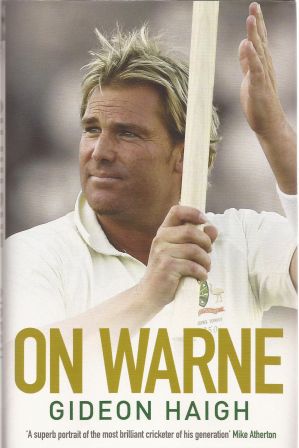
On Warne
Return to the book list for this category.
Gideon Haigh, London Simon & Schuster, 2012. ISBN978-1-47110-110-6
When the world’s best cricket writer writes a book on the world’s most intriguing cricket, the publisher should be onto a winner. In this case they certainly are.The writer suggests that only two cricketers in the modern era can compare with Warne’s persona – Sachin Tendulkar and Ian Botham. Tendulkar, the author suggests, coped by hiding himself from the public, Botham by “allowing his legendary self-belief to become self-parodic”, while Warne was simply “ready to be famous, so comfortable with the limelight”. Warne was “Australia’s best-known sportsman; perhaps even the most recognised Australian”.
The book takes us through his life in five chapters. The author is at his best in analysing the greatness of Warne and expressing it: “Warne didn’t just rock up and roll teams over. He niggled and nagged, badgered and bewildered, perplexed and panicked – and then he struck” and “The victims would seem to have been defeated by the magnitude of the deviation, but the credit belonged as much to the long, steady building of pressure, the gnaw of isolation and indecision that had preceded the wicket”.
The book recounts a conversation between Shane Watson (who was bowling) and Warnie during a T20 game. Watson said that he was just looking to keep things quiet. Warnie replied: “Naaaaaaaah, that’s no good. How are you trying to get this guy out!”
There are some fascinating discussions of the key moments in Warne’s career:
The Gatting ball which the author sees as incredible courageous to commit to that all or nothing delivery first ball. He compares it to the Pele feint.
The dilemma for Australian captains to accommodate McGrath and Warne. Do we bowl first to allow McGrath to get at them early or bad first so that Warne can bowl them out in the fourth innings? The author argues that Warne was never at his best when McGrath was in the team.
I also enjoyed the section on Warne’s psychology with umpires, befriending them, telling them they were right not to give the batsman out or even OK umpire, I am sure you are right, “even if you are the only person in the ground who can’t see that that was out”!
There are some great one-liners:
Criticising Warne was “as awkward as discussing a divorce in front of the children”.
“You had to see Bradman to believe him; you had to see Warne again to believe him”.
Australia was “led to world supremacy by Mark Taylor, Steve Waugh and Ricky Pouting relentless, superbly drilled, devastatingly efficient, but it was Warne who imparted their sheen of glory”.
Warne’s epitaph is: “Cricket is not after all so important; I’m bound to say that by several rigorous measures it may even be judged quite trivial. But being day in, day out for nearly two decades the best at something that there has been is assuredly not.”
A great book, well worth reading.