
If I had to choose between my wife and my putter... well, I’d miss her.
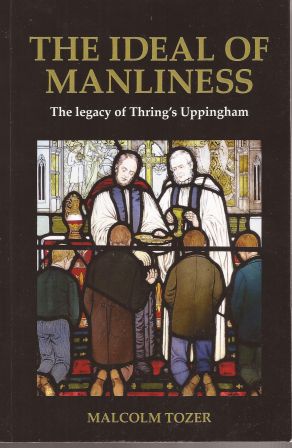
The ideal of manliness
Return to the book list for this category.
(The legacy of Thring at Uppingham), Malcolm Tozer, Truro, Sunnyrest Books, 2015. ISBN978-1-326-41574-7
The book represents an excellent contribution to our understanding of manliness in the 19th century, with particular reference to public schools. The author argues that Muscular Christianity flourished as it seemed “a breath of fresh air against the mawkishness of Evangelicalism and the piety of the Tractarians”. It was also significant that it was an era when some of society’s ablest men became headmasters.
Defining “manliness” is not easy – especially when one has to distinguish between the negative version and the positive “true manliness”. The principles of true manliness include “Never cheat, never funk, never lose temper, never brag.” Edward Thring, headmaster of Uppingham School, saw his role as carrying out God’s plan through “opportunities for manliness and self-denial … in the work and the games, in the in-door life and outdoor life”. The author suggests that the definition changed significantly over time with the later version of “reliance, courage and sportsmanship” being some way from Thomas Arnold’s earlier ideal of manliness.
The idea that to be known throughout England for true manliness in the 1880s would a better thing than to have a name for cricket is a fascinating concept.
Thomas Arnold is often described in popular literature as the father of Muscular Christianity. The assessment of Arnold was, for me, one of the most interesting aspects of the book. Arnold is described as the first headmaster who sought to inculcate the ideal of manliness in his pupils. However, the overall assessment of Arnold is quite critical: “It is perhaps hard to say that Arnold failed as a headmaster but, in many vital ways, he did”. The assertion is supported by evidence of his heavy-handedness, narrow-mindedness, arrogance and being a “bad-tempered bully”, who related badly to the boys and rarely remembered their names.
It was, rather, it is argued, Charles Kingsley who did most to bring the ideal of manliness to public attention. Kingsley spoke highly of Arnold with whom his views “coincided warmly.” Kingsley suggested that one of Arnold’s greatest contributions was to make education truly Christian.
Thring was “arguably the most influential figure in public school history since Arnold”. The book suggests that his life’s work was to put the ideal of manliness into practice in his school with the aim of making a boy “manly, earnest and true”.
HH Almond, headmaster of Loretto, who longed for “a holy alliance between the athlete and the Christian” saw great value in sporting competition with other schools in that they give opportunity to display “the spirit of chivalry, fairness and good temper” while testing their relative manly strength.
Just as popular opinion sees Thomas Arnold as the godfather of Muscular Christianity, Tom Brown’s Schooldays is seen as its holy writ. Again the book helpfully challenges some of the myths. Thring is quoted as calling the book the “bitterest satire” showing a school resting entirely on Arnold’s personality, with Thring adding “and my own experience more than supports its truth”.
It is further suggested that Tom Brown’s Schooldays “was partly responsible for the tilting of the ideal of manliness towards the physical noting that one could easily infer that Tom Brown was at Rugby just to play football with any academic work very much secondary.
An excellent contribution to the literature on Muscular Christianity and manliness, which should be read by all serious students of the topics. The way the book provides evidence to challenge the received wisdom in a number of places is a particular strength.