
If I had to choose between my wife and my putter... well, I’d miss her.
The Ultimate Prize
Return to the book list for this category.
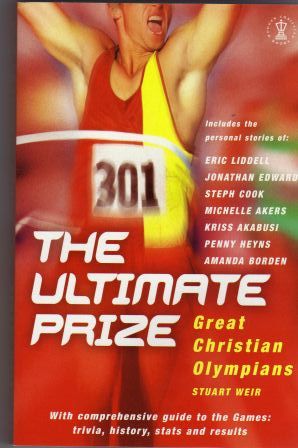
The Ultimate Prize, Stuart Weir, Hodder and Stoughton, London 2004 (224 Pages with 8 pages of photos) ISBN: 9780340862254
"Ever wondered what effect an athlete's faith has on their athletics performance? Stuart Weir addresses this question in The Ultimate Prize. Described as 'the perfect armchair companion to the Olympic Games' the Ultimate Prize is erupting with fascinating facts, figures, results and incredible stories of personal sporting achievement...
"A scintillating twist comes at the very end, with enough Olympic trivia and statistics to make you bubble over with excitement. The ultimate Prize proves an intriguing read that doesn't fail to communicate the true meaning of the Christian faith and its powerful impact on sporting success." Athletics Weekly
"Combining personal stories with Olympic facts and figures, The Ultimate Prize is an enjoyable light read ahead of Athens 2004. Ideal for all sports fans, especially those of track and field athletics, The Ultimate Prize opens with a good synopsis of the history of the games and goes on to tell the stories of Christian olympians including Jonathan Edwards, South African Penny Heyns and American Michelle Akers. The book includes some interesting Olympic trivia and also contains a chapter on the evangelistic and pastoral opportunities the Games afford. An ideal book for Summer holiday reading and a useful tool for personal witness and evangelism". http://www.thegoodbookstall.co.uk
Published to coincide with the Athens 2004 Olympics, this is the perfect book for anyone who wants to know what makes an Olympic participant tick, what's behind the Olympics or would like a reminder of some of the best moments in sporting history.
The book starts with a historical perspective on the Olympics – and if, like me, you were under the impression that the Olympics have always been there, an unbroken line of tradition from ancient Greece to today, you'll be in for a few surprises. The modern international Olympics started up only just over a hundred years ago, founded by Baron Pierre de Coubertin in 1896 after a break of well over a thousand years (discounting the British "Olympicks" that ran from 1612 - 1852). As for the Olympic Flame – that didn't appear until Amsterdam's 1928 games.
A brief resume of each year's games highlights key events, followed by a chapter dedicated to "Memorable Olympic Moments" with a roll of honour – and dishonour. The mainstay of the book, however, comes in Chapters 3 - 11, which recount the personal stories of a number of Olympic champions whose Christian faith has given them the strength and determination to give the games their best. No book on the Olympics would be complete without a chapter on Eric Liddell, made famous by the film Chariots of Fire, then we have – amongst others – chapters on Kriss Akabusi, Jonathan Edwards, Steph Cook and Michelle Akers. Each chapter is based on a combination of meticulous research alongside personal conversations, exclusive interviews and individual correspondence with the author giving him a unique insight into their lives and faith.
The book closes with a fascinating collection of "Olympic Trivia" (can anything be trivial about the Olympics?), perfect ammo for that quiz evening that's inevitably going to come up before the year's over, followed by a set of appendices giving us the 100m Men's and Women's Gold Medallists from 1896 - 2000, a comparison of results for 1896 and 2000, and a full list of Sydney 2000's Gold Medallists.
All in all this is – as the publishers have described it – "The perfect armchair companion to the Olympic Games." Whether you're going to Athens or watching the games from the comfort of your own home, make sure you have a copy of this book handy for maximum enjoyment – and a spare copy to give to a friend or neighbour. Phil Groom, July 2004, www.christianbookshops.org.uk
There is a lot of fascinating information about the history of the Olympic Games starting in Athens in 776 BC to the 2004 AD Games also held in Athens. The book includes stories of some of the champions who went for gold in the Olympics but who were proud to count themselves Christians. Athletes such as Eric Liddell, Kriss Akabusi and Jonathan Edwards share what their faith means to them. Various women feature too, Dr Steph Cook who won gold in Sydney and Michelle Akers who overcame tremendous adversity with God’s help to win gold in Atlanta. Wider World,
Presbyterian Church in Ireland, December 2004
FOR this summer’s Olympic Games in Athens, Stuart Weir, of Christians in Sport, has compiled The Ultimate Prize: Great Christian Olympians. The book contains a brief account of the games’ history, together with interviews with some of the medal winners from the Sydney Olympics in 2000, including Jonathan Edwards and Steph Cook. There are also accounts of past Olympians such as Eric Liddell and Kriss Akabusi, Olympic trivia and appendices giving comparisons between the results in 1896 and 2000 and lists of medal-winners. The book stands witness to the demonstration of Christian values in the face of the pressures of ultra-competitive sport and the fame which can follow success. Methodist recorder, 19 August 2004
Modern day athletics is fiercely competitive, highly lucrative business, plagued with rumours of drug-taking and gamesmanship.
Yet within this world, a handful of athletes have retained their faith and integrity and still conquered the world.
This look at great athletes who have managed to combine their ambition and religious beliefs is a reminder of the true nature of personal achievement and the part sporting excellence can play in our lives.
Includes profiles of Eric Liddell, Kriss Akabusi and Jonathan Edwards. Songs of Priase, Summer 2004
As someone who makes his living from sports journalism, I occasionally turn my thoughts to what the future holds for sport. The scandal over Cathal Lombard’s drug taking has concentrated the mind of many of us on what is basically a moral problem.
Organised sport only took off in the second half of the 19th century, mainly due to the founding of the Football Association, the Rugby Union and the Royal & Ancient (golf) in Britain. The Gaelic Athletic Association and American baseball were established about this time too. These were followed in 1896 by the revival of the Olympic Games.
These organizations brought order to their various sporting disciplines and have prospered accordingly. However, a century ago, the emphasis was laid as much on amateur sports— which is what the Olympics celebrates – as originally espoused by the Rugby Union and the GAA — as it was on the professionalism of the Football Association. There was in these islands an element of social snobbery, as in cricket, with the distinction between Gentlemen and Players. But since then sport has become increasingly professionalised. Amateur has become, not a term of praise, but of contempt.
However, current trends indicate that some of the bigger sports may have peaked and that the seeds of their own dissolution may already be present. I refer especially to the huge emphasis on win at all costs leading to abuse of the competitors, most notably through drug-taking, and obscene payments made to, in many cases, very average sporting talents, which have placed, respectable clubs/employers in danger of extinction.
In another 100 years, sports as we know it may be gone and the public’s interest could be invested in some other hobbies or pastimes. What a relief for our descendants if they no longer have to endure the over the top hype which accompanies every sport shown on the Sky Sports channels.
It could happen too, as Stuart Weir’s book on the Olvmpics illustrates. The Olympic Games, which began in 776 BC lasted for over 1,000 years until 393-4 when the religious rites which were associated with them were banned by Theodosius, the Christian Roman Emperor and, as a result, the Games died out.
When Baron Pierre de Coubertin became concerned about French education, he wanted to introduce an element of physical education and from this he developed the idea of resurrecting the Olympic Games. His noble idea that the Games were not about winning but taking part was one of the first victims of their success as nations drove their athletes to extremes in their pursuit of the coveted gold medals.
Certainly since the Berlin Games of 1936, which were recorded in all their Aryan glory by Leni Riefanstahl in that extraordinary film, Olympia, national glory rather than personal pride have been a dominant factor. Drugs have added another dimension.
Stuart Weir puts the focus on seven Christian athletes who completed successfully at the Games in a variety of disciplines – athletics, football, gymnastics. He tells of their sporting achievements and how each of them came to have a special relationship with Christ as their saviour. Some are well known, like Eric Liddell, the “Flying Scotsman” of Chariots of Fire, others little known outside the USA
It’s a slight enough book, padded out with a summary of the modern Games, a number of Olympic records and results, and other trivia, and an account of the evangelical Christian ministry to major sporting events which began in 1968 at the Winter Olympics at Grenoble.
For all its worthy purpose, this book is unlikely to this book is unlikely to become a best seller in either the sporting or religious genre. Sean Ryan in The Irish Catholic