
"Lord, I don't ask that I should win, but please, please don't let me finish behind Akabusi."
What the book says about sport
Return to the book list for this category.
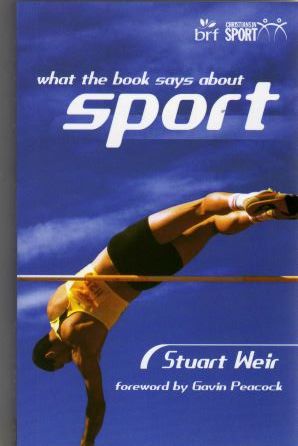
What the book says about sport Stuart Weir, BRF,2000 (144 pages) ISBN 1 84101 148 7
This book gives an excellent overview of how we can integrate our Christian living with our sport. Writing from a clearly evangelical viewpoint, Stuart Weir seeks to challenge and encourage the athlete (whether professional, university, club or at church) to be Christ-like. Sport, he writes, is a gift from God for us to enjoy. As Eric Liddell wrote: ‘God made me for a purpose but he also made me fast, and when I run I feel his pleasure,” This is the theme of the book.
The author outlines the significant number of references in the Bible
to sport but is careful not to take passages out of context to push his point home. His ‘theology of sport’ comes from taking the clear biblical principles on being a disciple of Christ and applying them to the sports-person: seeking to glorify God in our sport (not ourselves, which we an so easily do!) and to witness to our team-mates.
Stuart talks from his own experience plus that of other well-known sports people, with great honesty. He is not afraid to ask the tough questions, such as: Should we play on Sunday? Can I be a Christian and competitive? How do I deal with losing? How can I love the opponent?
The book ends with very practical advice on how the church can reach out to the community through sport, advice which can also be applied in the CU context. It is a very readable book challenging you to the core as a sportsperson to be an ambassador for Christ on the pitch. Read it and be prepared to change! Review by Emma Brewster, Ibid, UCCF
Christians involved in sport may find themselves struggling to blend Christian ethics into a sporting world that emphasises one-upmanship and self-glorification. Stuart Weir's What the Book Says about Sport answers many questions the reader may have about this conflict. Mr Weir addresses issues such as the ethicality of a sporting event on Sunday, God's attitude toward winning and losing, spending time in sport instead of elsewhere, sport-Church relations and using the sporting world to promote a Christian message. A foreword by Gavin Peacock, Christian and veteran English footballer, lends inspiration to any young person wishing to find a balance between the importance of sport and Christianity. Review by The Methodist Recorder
What does the Bible say about sport? Enough to fill one volume, obviously according to Stuart Weir’s new book, What the Book Says About Sport. Stuart Weir is the director of Christians in Sport and has co-written a range of books with well-known Christian sportsmen. This book looks closely not only at the Bible’s teaching on sport, but also at sport as a tool for evangelism and its uses in parish life.
Christian bookseller, May 2000.
Among other things, he looks at whether there can be a theology of sport, and at sport’s relevance for the church today. Church Times 2 March 2001
As we have seen over the past few weeks, few things generate as much passion for men as sport. Stuart Weir, who lives in Cumnor, is a director of Christians in Sport and he argues that sport was created by God to be enjoyed and can be the ideal vehicle to draw people into Christianity.Oxford Times, 30 June 2000
This is an easy-to-read exploration of the issues facing today’s Christian sportspeople. The author is a director of Christians in Sport, with particular responsibility for evangelistic resources for major sports events.
An early analysis of the biblical sources makes it clear that there is no prohibition of sport in the Bible. Rather, sport is part of God’s creation. The point is made that we, as Christians, should aim to worship God and represent Christ at all times. A number of extremely relevant points are made. A worthy example is that it is important for sportspeople to get their self-worth from God and not subscribe to the ‘only as I good as your last game’ mentality.
It is a challenge of the Christian athlete to compete as Christ would compete. That means that we can be competitive; indeed we must give the proverbial 110%, and not merely resign ourselves to being loveable losers. Christian competition is about striving to maximise the gifts God has given us, in a competitive environment.
Weir comprehensively addresses the issue of sport on Sunday, offering a number of examples to illustrate the point that it is not a choice between Christ and sport; the two are perfectly compatible, even on a Sunday.
Furthermore, Christian sportspeople have a fantastic opportunity for witness, a point emphasised a number of times.
Weir uses many real-life examples and quotes sportspeople, including Kriss Akabusi to help illustrate the vital role of Christians in Sport.
What the book says about sport is not only interesting, sport is not only interesting, but is a helpful guide to Christians who are involved in sport at any level, from the professional, to the supporter of the village team. I strongly recommend it to all. Andrea Cummins Captain of the Oxford University Women’s Hockey Club and theology student in The Door
Stuart Weir paints on a broader canvas than just football. As a director of Christians in Sport (and a member of Kidlington Baptist Church) he is well placed to provide a for the Church seeing sport not as a threat or a diversion but as a challenge and an opportunity.
He acknowledges that some of the book’s contents also appeared in the 1993 title More than Champions. No doubt much of the material has appeared in one form another in the course of the development of Christians in Sport’s ministry.
But it is helpful to have it all in one volume: discussions about the competitive instinct and Sunday sport, among other subjects, anecdotes from Christian sports stars and suggestions for churches to follow both in relating to national sporting events and in getting involved locally in a sports ministry. John, Capon, Baptist Times, 8 June 2000
A comprehensive look at sport and Christianity bu one of the directors of Christins in Sport. An inspiration to use your sporting passions for the gospel, complete with Biblical wisdom on why and how. Deals with the thorny issues of sport on Sunday, competitive spirit and who God really supports with Candour and balance, quoting professional sports people who have faced the issues first-hand. An easy read but never simplistic. Buy it for sports nuts or those who need to be informed that it is OK to be keen on sport and a committed believer.
HIGH POINT: The breadth of opinion and quotes from Christian sportspeople.
LOW POINT: It needed to be longer to develop themes in more detail. Andy Peck, Christianity
Stuart Weir is a member of Christians in Sport, and has ‘recently written a book entitled What the Book says about sport. Rev. Philip Hacking, responds to a very important chapter in the book on the theme of sport on the Lord’s Day.
There are important issues at stake here. Christians should avoid legalism of the kind Jesus condemned in His generation on Sabbath observance. But there is no doubt that the fourth commandment is of a piece with the rest and since we insist on not going soft on the Commandments, we dare not make any exception. We rejoice at the change of Sunday, the Lord’s Day, with its message of resurrection hope, but surely the principle remains of one day a week given over to God as a benefit to mankind. The New Testament does give us injunctions, as in I Corinthians 6, about giving on the first day of the week. We know from other Scriptures that the disciples met on that day and it being very special to them because of its Easter connotation.
Stuart Weir’s book suggests that there was no commandment about Sabbath observance before the Fall and that, therefore, in regenerate Christians it is not necessary. Surely we still live in a sinful world and with our hearts we have our own continuing sinful tendencies. Therefore it still remains important that the Sabbath was made for our benefit.
Sabbath was made for our benefit. Rest in Hebrews has become a synonym for abiding in the presence of God now and the glory of the rest of heaven to come. This would be to contradict the later command in the same letter that we should not forsake gathering with the people of God.
It is possible to argue that professional sports people, occupied elsewhere on Sunday, should be able to keep their Sabbath on a different day But it does not take too much thought to realise how impossible it would then become for the people of God, in any one place, ever to meet together and thus deny the whole concept of the body of Christ.
Stuart Weir wants to argue in his book that the professional sportsman is actually, as a Christian, glorifying God through his sport. I found this a very ingenuous concept. As a practising sportsman of a kind, it never occurred to me that by playing cricket I was glorifying God, and I think this is probably a mere matter of words. Of course, there are people whose occupations on Sunday are necessary because of the health of society and our safety. To argue that sport comes in the same category is very dubious indeed. As I see it, the problem is much more how we can encourage our young people to enjoy sport on a Saturday, and still keep Sunday special for God. It does not help when they see Christian professionals setting a different example.
Two other issues are often raised. In the first place, there is the argument from experience, and Christian sportsmen will say that God had called them to run or play sport on Sundays. It is impossible to argue against that comment, but it is a dangerous foundation.
Equally, there is the argument bout witness. It is possible for Christians to witness to non-Christians by sharing with them in Sunday games. But the witness argument is a double-edged sword. There is no doubt that Eric Liddell in his day was a witness, and certainly to myself as a Sunday school boy,a very powerful witness as I heard the story of one who honoured the Lord’s Day and believed that God honoured his stand with victory on another day.
I wonder whether we are seeing yet another erosion of biblical standards faced with the culture of our day. Very often it is with the best intention in the world that we should be involved with our fellow men and women in that which comes most naturally to us in the way of sport.
But if we are to turn our back on the obvious teaching of Scripture on this issue, I find it hard to believe that God can honour our testimony. I find this difficult because I do love sport, it has meant much to me in my life, and I feel cheated when I cannot be involved in watching professional sport on the Lord’s Day. It may be that the Old Testament principle that the Sabbath was one the great marks of the loyalty of the people of God, cannot be translated into New Testament terms, but I believe the principle is still in many ways relevant. Perhaps that revival blessing we all want may be waiting upon our obedience in this particular issue as in many others that challenge us today. Philip Hacking, Evangelicals Now