
“Knowing Christ is the best thing that has ever happened to me, although winning the US Open was a pretty good second.”
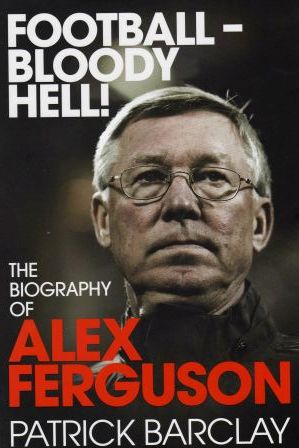
Football Bloody Hell
Return to the book list for titles beginning with 'f'.
The Biography of Alex Ferguson, Patrick Barclay, Yellow Jersey Press London, 2010
Alex Ferguson is surely the most interesting man in British football and Patrick Barclay an outstanding writer. It seems a winning combination – and it is. The book charts his playing career and his managerial career at East Stirlingshire, St Mirren, Aberdeen, Scotland and Manchester United
Ferguson’s perception of people is well summed up in a quote from Ricky McFarlane, who worked with him at St Mirren, “You’re either with him or you’re not”.
There are some great stories from the early days such as Ferguson as manager of East Stirling leading his team to victory over Falkirk in local derby. “Ferguson then got up to some more of what we now recognise as old tricks, telling his team the local press were biased in favour of the bigger club but then going through Falkirk’s individual weaknesses – lack of pace, one-footedness and so on to the extent that his men went out thoroughly believing they could win”. (Page 80)
Or the amazing story of Mark McGee (then an Aberdeen player) having to be restrained from hitting Ferguson and coming in next day to apologize. “McGhee started to apologise, but Ferguson cut him short. ‘It was my fault,’ he said. ‘Behaved badly.’ McGhee continued down his own road of penitence, adding that he had been drunk and … ‘Forget it,’ said Ferguson. ‘It’s done’. (Page 147)
The book is at its best in the analysis of what makes Ferguson tick, his approach to management and his place in the pecking order of all time greats. The weakness of the book is the tedious, descriptive, season by season accounts – which most readers will know.
Ferguson once ascribed his longevity as a manager to four factors. mental equipment (enthusiasm and determination), health, delegation and joys, which included horse-racing. In a talk he identified “Power and control” as keys. “Through my development I’ve come across two issues - power and control; Not necessarily in that order. ‘Control is important, very, very important. My control is the most important thing. If I lose control of these multimillionaires in the Manchester United dressing room, then I’m dead. So I never lose control. If anyone steps out of my control, that’s them dead”. (Page 435).
On another occasion he said the three most important qualities required for leadership, were control, managing change and observation. Observation was defined as: “Spotting everything around you, analysing what is important. Seeing dangers and opportunities that others can’t see. That from experience and knowledge.” (Page 437) Barclay quotes Thomas Carlyle to describe Sir Alex as having, “an infinite capacity for taking pains”. (Page 265)
The analysis of his management of players like Roy Keane, Eric Cantona, David Beckham, Cristiano Ronaldo, Wayne Rooney and Gordon Srtachan makes fascinating reading.
Comparisons of Ferguson with other managers sees Barclay at his most intuitive. He took much longer to achieve success than Brian Clough but then outlasted him.
While Ferguson cannot match Jose Mourinho’s 3 European Trophies in seven years, there is a gap of 24 years between Ferguson’s first and fourth.
There are some great one-liners in relation to managers:
Mourinho was “not as sporting as Ferguson at his best. And sometimes as graceless as Ferguson at his worst”.
While Wenger “was often the most sour of losers, he was never an ugly winner”.
“Ferguson is not a genius, as Brian Clough (with Peter Taylor) was in the early years of Ferguson’s career in management and Jose Mourinho has been towards the end”.
The subtle difference between Ferguson and Mourinho was identified: “Ferguson is a dictator of conviction rather than ego”.
Pages 438-9 compare Ferguson with Busby, Clough, Shankly, Wenger, Mourinho etc. And reaches the conclusion that “Ferguson is up with the very best of the rest”.