
If I had to choose between my wife and my putter... well, I’d miss her.
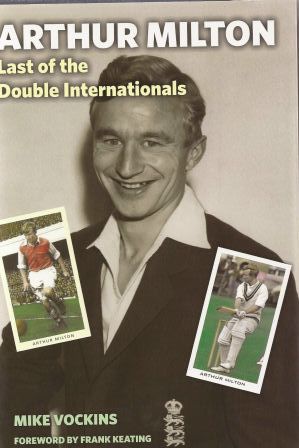
Arthur Milton, Last of the double internationals
Return to the book list for titles beginning with 'a'.
Mike Vockins, Sports Books, 2011. ISBN 9781907524 03 5
The story of Arthur Milton reads like a fairy tale. He plays cricket for Gloucestershire and football [or soccer as the author insists in calling football for some bizarre reason] for Arsenal and is capped by his country in both sports. Then after his career is over he becomes a postman and after retiring from that, he delivers newspapers.
This is all put in context by the following quote from Donald Shell, which in a way sums up Milton’s life: “I remember saying I didn’t think David Beckham would be delivering newspapers on a pedal bike when he had retired. Arthur’s response was that he absolutely loved what he did, and also felt that when he played football – probably for a paltry match fee – he and his contemporaries actually had far more fun out of the game than current players.”
Frank Keating writes in the introduction, “Bristol University gave Milton an honorary MA. That morning he’d delivered the newspapers to the Common Room. How many other universities anywhere in the world have given an MA to their paperboy?”
The book makes a great contribution to the social history of professional sport in the 1950s and 1960s. In the modern era where the football season seems to end in June and restart in July, the idea of a Premiership player being a county cricketer is preposterous. Yet it was not that unusual in Milton’s day. The book lists twenty or thirty others who did the same. There is a story of Brian Close who was due to play for Yorkshire during the day and for Arsenal Reserves in a Cup Final the same evening!
In 1952-53 Arsenal were league champions. Arthur is quoted describing it as “the highlight of my football career when we won the First Division championship”. Not that Arthur was there to celebrate. By then, he had returned to Bristol for the start of the cricket programme! Can you imagine Arsène Wenger releasing a player from a championship decider to play a different sport?
In those days cricket and football clubs shared players and agreed dates at the beginning of the year and stuck to them.
The explanation in Chapter 13 of why Arthur was passed over for the captaincy of Gloucestershire in favour of a less suitable and less experienced player is another insight into the world of cricket at that era. The reason was, of course, that Arthur, as a professional, was by definition not suitable as a captain if there was an amateur available!
The spirit, in which the game was played, comes out clearly when Arthur comments on his two great mentors, Jack Crapp and George Emmett: “Well, George and Jack would teach you your cricket – and they taught you your manners, too. You knew if you nicked it you had to go, or else you would be in trouble.”
The book is over 300 pages long and, in my view, would have benefit from being cut by at least 50 pages. As someone who has written three biographies myself, I have wrestled with how to paint the picture without including endless accounts of this match and that match and who scored. I felt there was too much detail about routine county games. And I am not sure I needed to know what David Graveney thought of Milton’s golf grip or about his interest in greyhound racing in quite so much detail. Again two pages of Milton’s biography are devoted to the appointment and sacking of Andrew Wingfield Digby as England cricket team chaplain – just because Milton coached him at Oxford!
The story of Milton needed to be told and we should be grateful to Michael Vockins for making it available to us. Vockins sums up his subject like this: “Arthur, surely, was the last of those sporting heroes inhabiting that era whose passing many deeply regret, of fresh-faced, clean-cut sporting idols often depicted on treasured cigarette cards. In the delightful imagining of their legions of fans, they could be weaving light-footed down the wing to score a breathtaking goal one afternoon and crafting an exquisite century the next. Arthur was, undeniably, a star of that age when players like him, modestly paid and not seeking or expecting privilege, could travel to Highbury by bus or tube amidst the fans, or jump on the train to Gloucester and the Wagon Works ground alongside dedicated supporters looking forward to a good day’s cricket”.