
“Knowing Christ is the best thing that has ever happened to me, although winning the US Open was a pretty good second.”
Chariots of Fire: bigotry, manhood and moral certitude in an age of individualism
Return to the book list for titles beginning with 'c'.
Ellis Cashmore, Sport In SocietyVol. 11, No. 2/3. March/May 2008,159-173
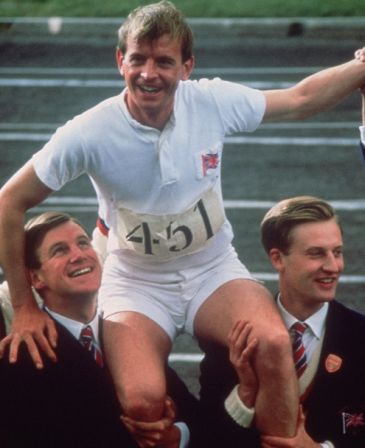
The article looks at Chariots of Fire in its historical context and in the context of the period of its release, concluding “the film is most profitably understood as an invigorating sermon for the 1980s, rather than a literal or authentic record of the 1920s”.
The author sees Chariots of Fire as “drama, not documentary or even docu-drama and certainly not cinema verite. As such, it makes no apologies for the way it mixes fact with fabrication. The timing of Liddell’s switch to 400 meters is a minor historical fudge; as is the elision of the athletes’ other ventures in the Games, or indeed Abraham’s previous defeats in the 1920 Olympics. Liddell’s sister might not have been keen on his apparent departure from his central mission, but there is no evidence that she counselled against it. The sham Cambridge challenge of die Trinity Dash is inconsequential”. He adds: “Abrahams and Liddell were actual people, but their stories are told as fables”. The film portrays a world where “sport cannot vanquish social inequity, but it transcends it”.
For the writer Liddell like Abrahams “ is driven by selfish concerns, in his case to satisfy his unyielding conviction that he is competing in God’s service. His version of evangelical Protestant Christianity equates to what later became known as fundamentalism, underpinned by a sense of certainty and intolerance of other faiths or other visions of Christianity. For Liddell, God was a ‘benign dictator’. As if to underline his obligation, Liddell pronounced it fulfilled when he left active competition to pursue his calling after the Games. British triple-jumper Jonathan Edwards, British hurdler Kriss Akabusi and German golfer Bernhard Langer are among the many Christians who, like Liddell, realized their calling through sport, Edwards, in particular, was compared with Liddell when he opted not to compete in the British trials for the Seoul Olympics of 1988 because his event fell on a Sunday”.
This is a helpful article which raises a number of interesting ideas about the lasting interest in Eric Liddell and Chariots of Fire.