
"there has only ever been one perfect man, the Lord Jesus, and we killed him. I only missed a putt."
Sport: Race, Ethnicity and Identity
Return to the book list for titles beginning with 's'.
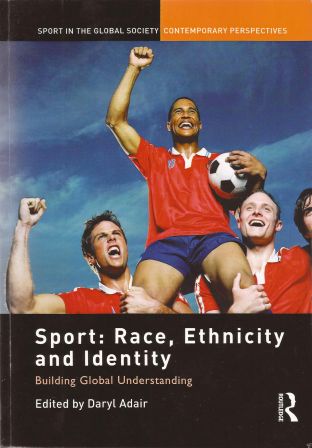
Edited by Daryl Adair, London: Routledge, 2014. ISBN 978-0-415-48354-6
The book consists of seven quite separate chapters on different scenarios in which sport has been affected by issues related to race, each chapter by a different author.
There are two chapters on South Africa bringing out alarmingly how much of the underpinning of the belief in white supremacy was based on Afrikaner and Dutch Reformed theology. How a view that God had made whites superior to blacks and intended whites to keep the blacks in their place can be justified from the Bible, escapes me but it was a pillar of the Apartheid system which kept non-whites from representing South Africa – irrespective of their talent – for generations.
An article on the Harlem Globetrotters quotes the American Secretary of State Dean Acheson in 1951 recognizing the potential value of the Globetrotters: “as ambassadors of goodwill, particularly in countries that are critical of U.S. treatment of Negroes…”. The author makes the point that one of the principal reasons that the Globetrotters had become one of the best basketball teams in the world was because they had a near monopoly on African-American basketball talent owing to the exclusion of African Americans from white-only professional leagues. He argues further that the antics and tricks which made the Globetrotters popular, at the same time, re-inforced the stereotype of blacks.
A chapter looks at the incident in 2008 when Harbhajan Singh allegedly called Andrew Symonds a monkey. One of the more interesting reflections in the chapter is the differing perceptions of what constitutes a racial insult. The author suggests that an Indian calling an Australian a bastard will not bother him while an Indian called a bastard will feel that his mother has been insulted. However with regard to being called a monkey, the Australian will be offended much more than the Indian!
The account of The lAAF’s Regional Development Centres is fairly critical of them, arguing that they have largely “engaged in classic Western development rhetoric, epitomized by neo-liberal modernization theories of development”.
A chapter on identities in Scottish international football focuses on the contribution of religion, Britishness and Irishness to perceptions of Scottishness and amongst the Tartan Army. The final chapter deals with the development of football in Australia from being a sport for immigrants and its attempts to become a major sport for all the population.
It is a really interesting book with covers a lot of ground, written from an academic standpoint but accessible to the general reader.