
"there has only ever been one perfect man, the Lord Jesus, and we killed him. I only missed a putt."
Amazing Grace
Return to the book list for titles beginning with 'a'.
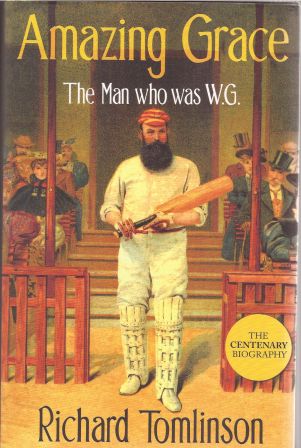
The man who was WG, Richard Tomlinson, London, Little, Brown, 2015. ISBN 978-1-4087-0517-9
The book examines the conundrum: How can a person who was a snob and a cheat – “the money-grabbing shamateur who fiddled his expenses, or the roguish Old Man who ‘refused to walk when given out” – become a national treasure, known simply by his initials?
As a cricketer, Grace was head and shoulders above everyone of his generation; thousands would flock to a game if he were playing. The book recounts an incident when he scored 0 in the first innings to the concern of the match organizer. WG assured him not to worry about the game being over too soon and proceeded to score 268 in the second innings!
There is a fascinating comparison of him with Don Bradman taking into account that Bradman played on perfect batting wickets and Grace on anything but. WG scored 126 first-class centuries and once made two triple-centuries in a week. He scored 74 at the Oval aged 58 and continued to play serious club cricket into his late 60s. His mother died during a country game. That the game was immediately abandoned as a mark of respect, indicates his unique standing.
At the same time he indulged in sharp practice on the field. The book gives examples: running out a batsman when everyone assumed the ball was deal; claiming a catch when the ball had clearly hit the ground; asking for the pitch to rolled, contrary to the playing conditions. On one occasion he was not out on 399 when the last wicket fell. He instructed the scorer to make it 400! The scorer did as he was told.
In Grace’s era there was a clear distinction between amateurs and professionals. Grace was always an amateur, playing annually for the Gentlemen v Players. In reality he was demanding “expenses” well in access of what the professionals were receiving. The Nottingham Express asked simply: “Can anyone for a moment look upon Mr W.G. Grace as being an amateur?” John Lillywhite’s Cricketers’ Companion, stated that Grace had “made larger profits by playing cricket than any other professional ever made” and accused the MCC of turning a blind eye. Pragmatically cricket was making so much money when Grace was playing that they were happy to bend the rules.
One thing which surprised me was Grace’s relationship to medicine. I had also thought of him working as a doctor and fitting cricket around it. It was clearly the other way round! He was effectively a full-time cricketer, taking a full-time medical post but employing a locum to cover his frequent absences.
The famous refusal to walk after being given out in a match, because the crowd had come to see him, is mentioned but not included as there is no eye-witness confirmation that it actually happened.
Grace is referred to as worshipping at St Andrew’s Church most Sundays. This may just have reflected normal practice at the time. There are no other references to a personal faith. In contrast the author twice refers to CT Studd, a contemporary, pledging his life to Christ and going to China as a missionary.
An excellent book which sorts the myth from the facts of WG Grace’s life and presents England’s greatest ever batsman, warts and all. It also gives great insights into cricket in the late 19th century.