
"It matters a great deal who is going to win, but not at all who won"
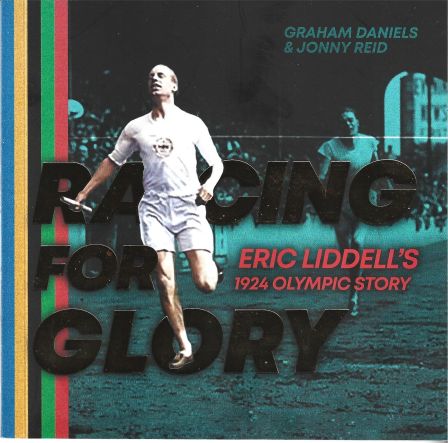
Racing for Glory
Return to the book list for titles beginning with 'r'.
Eric Liddell’s 1924 Olympic Story, Graham Daniels and Jonny Reid, 10 Publishing, 2024. ISBN 978-1-8-83728-000-1
The centenary of Eric Liddell’s Olympic gold medal has led Christians in Sport and 10 Publishing to bring the moving story to a new audience. In its own words their booklet “explores Liddell’s extraordinary life and how his faith in Jesus motivated everything he did”.
The well-designed, 32 page booklet, replete with original photographs takes the reader through the remarkable story of Liddell’s life as an athlete, a rugby international and ultimately a missionary teacher.
It is hard to look at Liddell’s career and extrapolate principles for the modern era. He won an Olympic gold medal but had no shoe sponsor, no central funding. It was very much an era of amateur sport. The world in which Liddell lived was so different from ours. One of the problems with learning from Liddell is that his fame is largely based on his refusal to compete on Sunday, something which would not be an issue for 99.9% of modern Christian sportspeople.
The weakness of the booklet is the authors’ use of fictional quotations from the 1981 film Chariot of Fire and giving them equal status as authentic quotations from Liddell. For example, the booklet begins was that brilliant quotation attributed to Harold Abrahams that the Olympic 100 metres final represented “10 seconds to prove his purpose in life”. I've always thought this one of the most brilliant summaries of the triviality and importance of professional sport. The problem is that this is a quotation from fiction. There is no evidence that Abrahams ever said this and according to Mark Ryan’s authoritative biography Running with fire, it did not equate at all to his thoughts in Paris, where he believed that he had little chance of beating the Americans. The booklet’s claim that after Abrahams won 100m, Liddell rushed to congratulate him is not confirmed by any of the main biographies. Ryan suggests that in Chariot of Fire : “There are understandable distortions of the truth…Some of the reasons behind the film’s power and resonance lie in the subtle changes [scriptwriter Colin] Welland made to the real story”.
Similarly that famous and much used quote from the film “God made me for a purpose – for China - but he also made me fast and when I run I feel his pleasure” was written by the Welland. When I exchanged correspondence with Welland he told me that he had written the line but he believed that Liddell would have said it! McCasland who wrote arguably the best biography of Liddell questions whether that is true: “I don't think that Liddell ever said that. Nor does it approximate how he felt about going to China or about running. He was a somewhat reluctant missionary initially, unsure if he could handle the task. Interestingly enough he never thought of his athletic prowess as being something God could use until D. P. Thomson suggested it to him in 1923”.
The authors may be right in their comment: “Liddell also ran for glory. He wanted the win too but had a bigger goal - to enjoy God's pleasure in using his God-given gifts”. But in terms of evidence this is drawn much more from the fictional Liddell of Chariot of Fire , than the historical figure. The view that Liddell had developed a theological position of seeing sport as an opportunity to worship is quite speculative. One could equally argue, particularly due to the influence of Rev DP Thompson who used to arrange evangelistic meetings for Liddell to speak at, that Liddell was more into the extrinsic value of sport then its intrinsic value as part of his Christian life. We cannot be sure.
I have sometimes wondered if Eric had known that his achievement would be used to develop a Christian theology of sport and indeed that his decision not to run on Sunday would be used repeatedly to guilt trip Christians who do compete on Sunday, would he have been pleased or horrified.
I'm sure that the booklet will succeed in keeping alive the amazing story of Eric Liddell.
Reviews of other books on Liddell can be found at Eric Liddell