
If I had to choose between my wife and my putter... well, I’d miss her.
Extra Time
Return to the book list for titles beginning with 'e'.
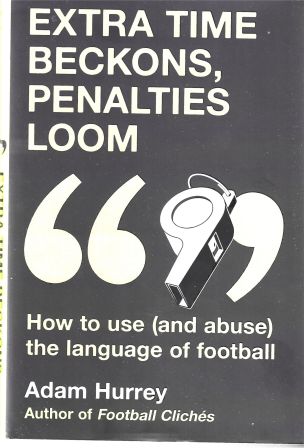
Extra Time beckons; penalties loom, Adam Hurrey, London, Headline 2024. ISBN 978 1 0354 0835
This is the silliest book that I have ever read but a book that I could not put down.
The definitions of cliches that we all use are dissected. The title makes that point clearly – that extra time can beckon (but not loom), whereas, of course, penalties can loom but not beckon!
And, by the way, I hope you know the difference between being rooted at the bottom and languishing at the bottom of the table.
The book addresses the great conundrum that keeps us all awake: whether a player leaves nothing out on the pitch or everything out on the pitch. I am sure, like me you also worry about the following conundrum: “Can a player score his first goal in his clubs colours if he is in the away kit?”
This is a book that gives the definitive answer to all those questions that haunt us:
When is a ground a stadium? If it has bowels, it is a stadium. I mean you cannot say the dressing rooms are in the bowels of the ground, can you?
You can salvage a draw. But you cannot salvage a win.
A goal can only be “nicked” bit really only in the away leg of a two leg game. And the score has to be 0-0. And the scrappier the goal the better.
We are told that against logic it is OK when scoring for the ball to be tucked home or tucked away.
And if you must refer to “a brace of goals” then they must be “bagged” not just scored.
But if you score two goals in rapid succession, that has to be called a double or a quick fire double.
And just to be clear, don’t try telling your mates that a game had everything unless you have licked off on the check-list: a red card, an own-goal, a missed penalty and a VAR intervention.
At one point the author takes 150 words to define what constitutes a goal line clearance, which incidentally doesn't actually need to be literally on the goal line!
The author worries about a team having the lion's share of possession, arguing that a lion eating his dinner would be unlikely to share any of it.
Commentators often tell us that a particular player is starting on the bench but not surprisingly, our author worries about this oxymoron as to whether a player on the bench is actually starting or not.
I loved the book’s dissection of the commentator’s favourite that “this referee is unlikely to be on the manager's Christmas card list”. The author helpfully points out, that it is probably fairly unlikely that football managers actually send Christmas cards to referees. And in any case, he worries whether the FA rules may in fact prohibit managers from sending Christmas cards to referees.
I hope that my review will convince you that this is a must-have book, but if anything is not clear, there are 164 footnotes which explain difficult issues more clearly!